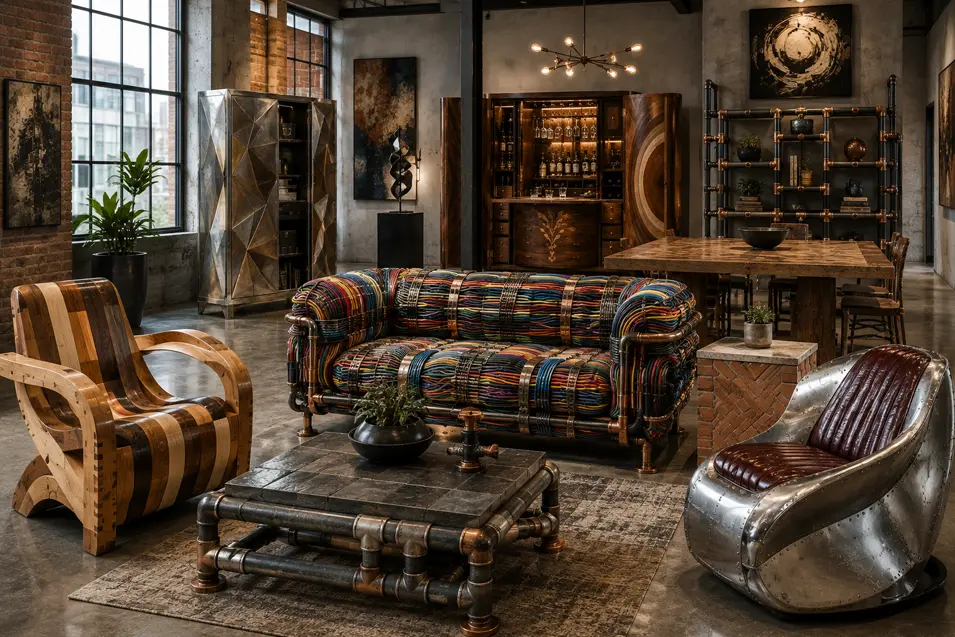
Furniture designers spend years thinking about materials, structure, proportion and how different pieces fit together.
Come to think of it, so do tradespeople.
A carpenter understands wood in ways most of us never will. A welder can turn flat sheets and lengths of steel into almost anything. Electricians spend their days organizing kilometres of colourful wire. Bricklayers create patterns from materials that most people see simply as walls.
So we started wondering what would happen if the people who build our homes were asked to furnish them too.
Not furniture inspired by the trades. We mean furniture actually designed around the materials, tools and techniques of each profession.
Some of these would be spectacularly impractical. A few would require a very understanding structural engineer. Others, surprisingly, look like they could belong in an expensive furniture showroom tomorrow.
Here are 20 pieces of furniture we’d like to see the trades build.
The Electrician’s Sofa
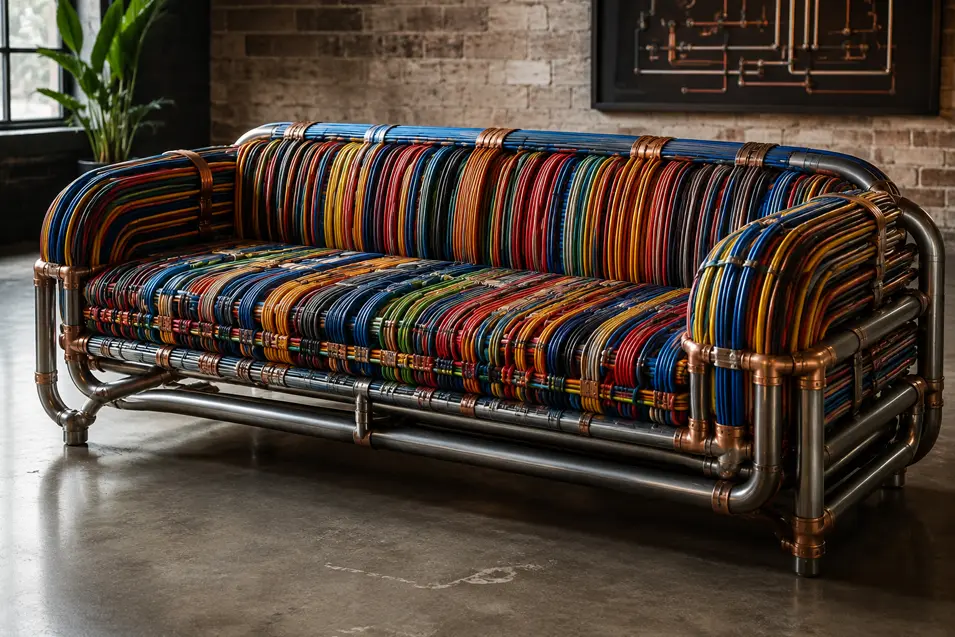
Electrical wire isn’t generally considered an upholstery material.
Perhaps we’ve been overlooking something.
Hundreds of lengths of brightly coloured cable wrap across the seat, back and arms of this sofa, organized with the obsessive precision you’d expect inside a beautifully wired electrical panel.
Heavy metal conduit forms the external frame while copper connections become decorative details rather than something to hide.
The result lands somewhere between industrial furniture and textile art. From across the room, the cables create bands of extraordinary colour. Move closer and you begin noticing how carefully every individual wire has been routed.
It might not be the sofa you’d choose for an afternoon nap.
But nobody walking into the room would ignore it.
The Pipefitter’s Sofa
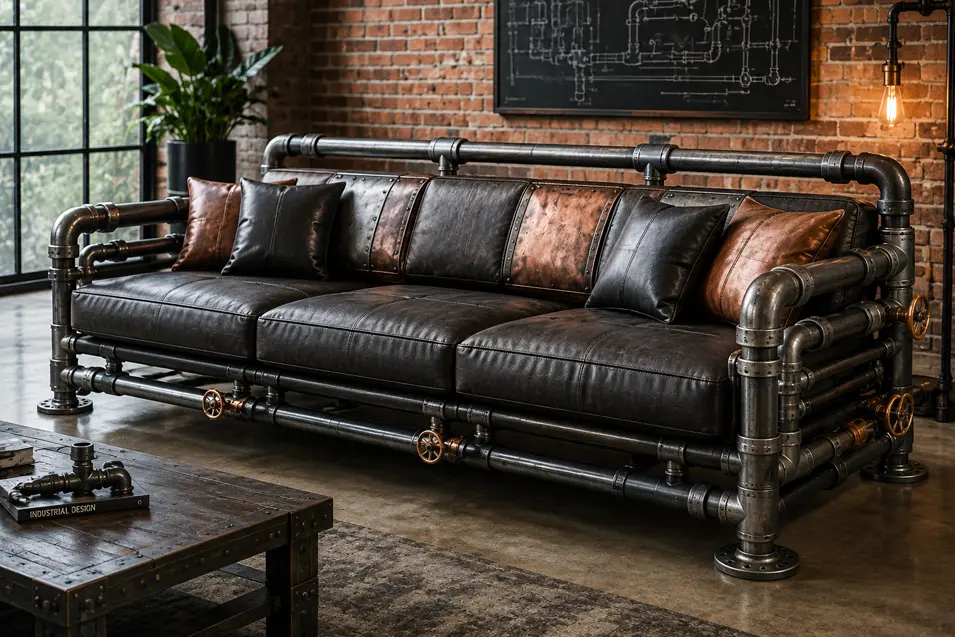
Give a pipefitter enough pipe, elbows, flanges and valves and apparently you don’t need a conventional sofa frame anymore.
A network of heavy black steel pipe wraps around this piece, forming the legs, arms, back and structural support. Connections remain deliberately exposed, with valves appearing in places where furniture designers might normally add decorative hardware.
Dark leather cushions soften the industrial framework while aged copper and brass introduce warmth among all that steel.
There is something wonderfully unnecessary about the complexity of it.
A normal furniture factory could accomplish the same structural job with considerably less material.
But where would be the fun in that?
The Carpenter’s Sofa
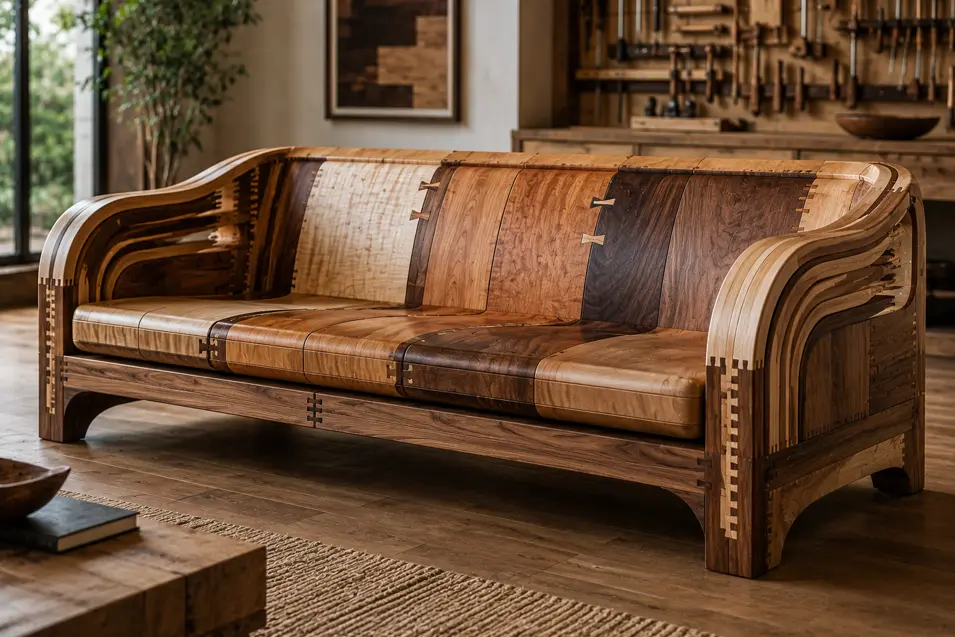
This is where the experiment suddenly becomes serious.
Rather than simply constructing a sofa from wood, our imaginary carpenter uses the entire piece to demonstrate what the material can do.
Different hardwood species create natural changes in colour across the seat and back. Dovetails are deliberately exposed. Butterfly joints become decorative elements. Laminated strips of timber sweep upward to create beautifully curved arms that would be almost impossible to achieve from a single piece of wood.
Nothing is covered with upholstery because covering it would defeat the point.
Every joint, grain pattern and transition is part of the design.
Of everything in this collection, this may be the piece that requires the least imagination to picture in an actual home.
Give the right furniture maker enough time and enough beautiful hardwood, and somebody really should build it.
The Welder’s Sofa
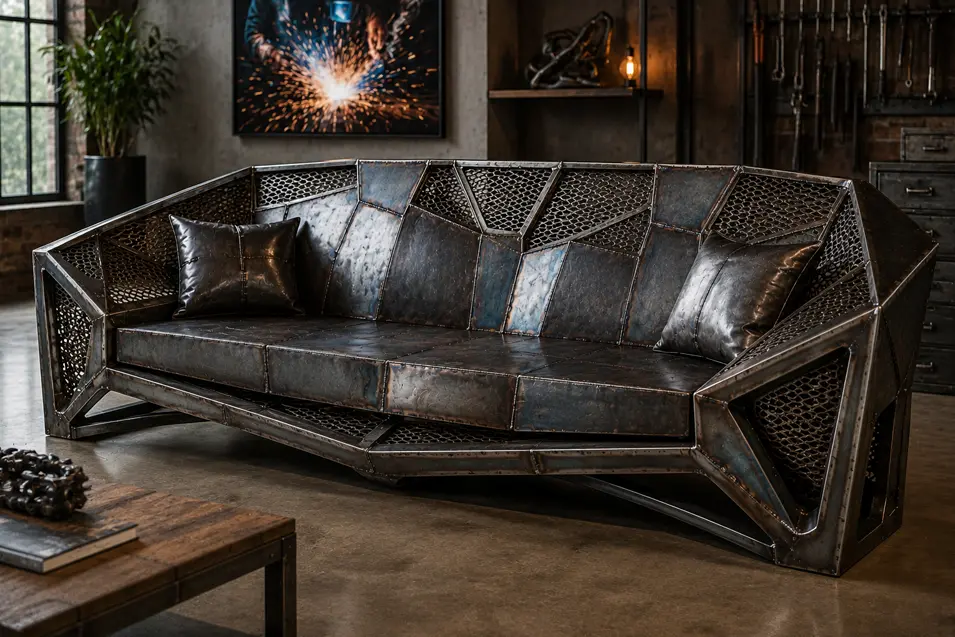
The welder has considerably less interest in making you comfortable.
Sheets of steel have been cut into irregular geometric panels and welded together to create a dramatic angular shell. Expanded metal fills portions of the arms and back while every seam proudly displays the process used to construct it.
Nothing has been polished until the evidence disappears.
Heat discolouration, grinding marks and visible welds become the equivalent of decorative stitching.
A few dark cushions provide a small concession to human anatomy, but this is ultimately a sculpture that happens to have somewhere to sit.
Put it in an industrial loft and it would look completely at home.
Getting it up the stairs might be another matter.
The Bricklayer’s Sofa
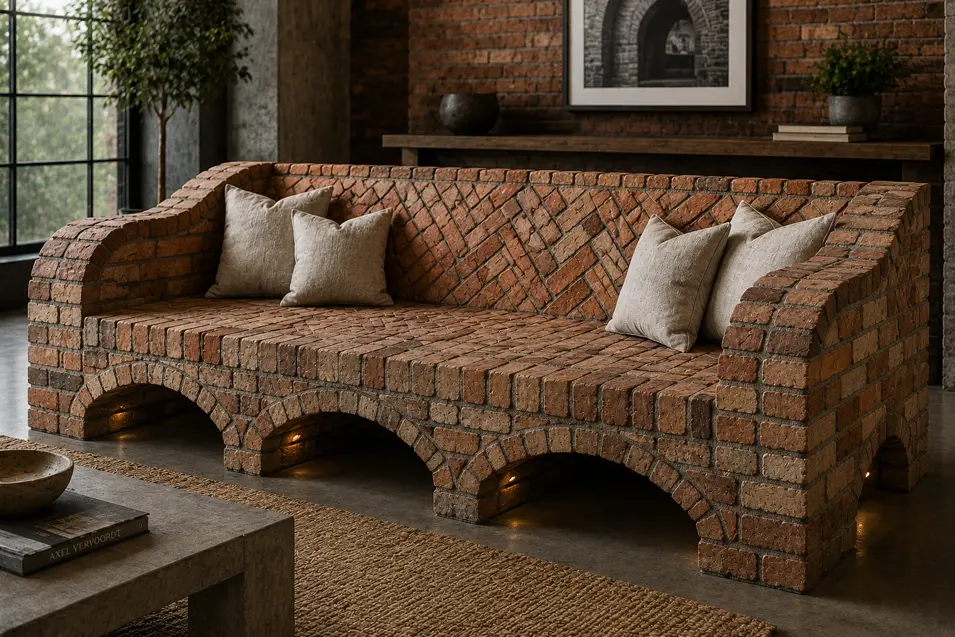
There are sofas that are difficult to move.
Then there is this.
Thousands of individual bricks form a massive sofa complete with sweeping arms, patterned back panels and small masonry arches beneath the seat.
Instead of simply stacking bricks into the approximate shape of furniture, the design uses traditional bricklaying patterns as decoration. Herringbone sections break up the back while carefully shaped arches demonstrate just how much can be done with one of construction’s oldest materials.
Loose linen cushions provide some desperately needed softness.
The biggest advantage?
Nobody is ever going to ask you to help them move it.
The Tile Setter’s Credenza
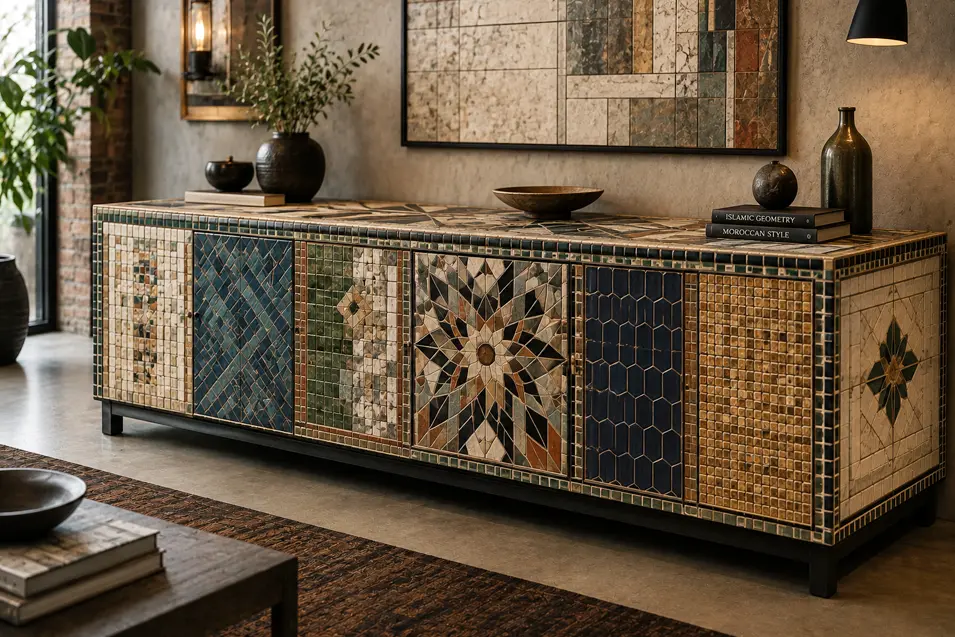
If there is one trade perfectly suited to turning furniture into pattern, it might be tile setting.
A long credenza becomes the canvas for hundreds of individually placed tiles in stone, ceramic and richly coloured glass. Rather than covering every surface with the same pattern, different sections shift subtly in scale and direction.
Tiny mosaics wrap around the doors. Larger geometric tiles define the top. Narrow strips follow the edges with almost architectural precision.
From across the room it reads as a beautifully patterned cabinet.
Up close, you realize the entire surface has essentially been assembled one tiny piece at a time.
The grout lines alone might drive the rest of us insane.
The tile setter seems perfectly happy.
The Concrete Finisher’s Coffee Table
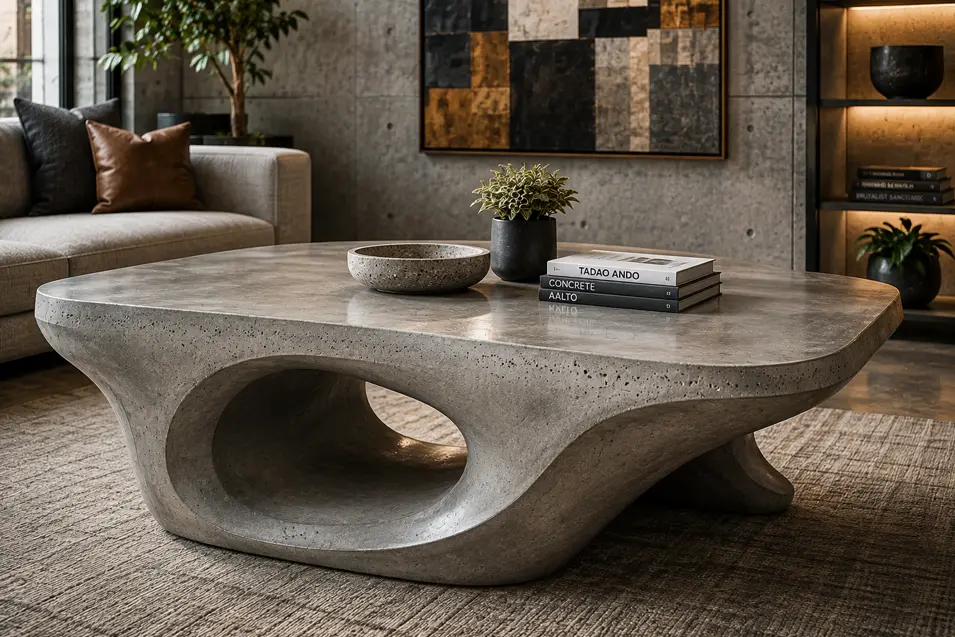
Concrete has already escaped the driveway.
We see it in countertops, sinks, fireplaces, floors and increasingly in furniture, so giving the concrete finisher a coffee table doesn’t require much of a leap.
What changes is the execution.
The table is poured as one continuous sculptural form, with broad curved supports flowing directly into a thick floating top. Portions are polished almost like stone while others retain subtle marks from the forms used during casting.
Small aggregate becomes visible along selected edges.
There are no screws. No brackets. No conventional legs.
Just an enormous piece of carefully controlled concrete that somehow manages to look elegant.
The coffee table may weigh more than your first car, but that’s a problem for another day.
The Glazier’s Dining Table
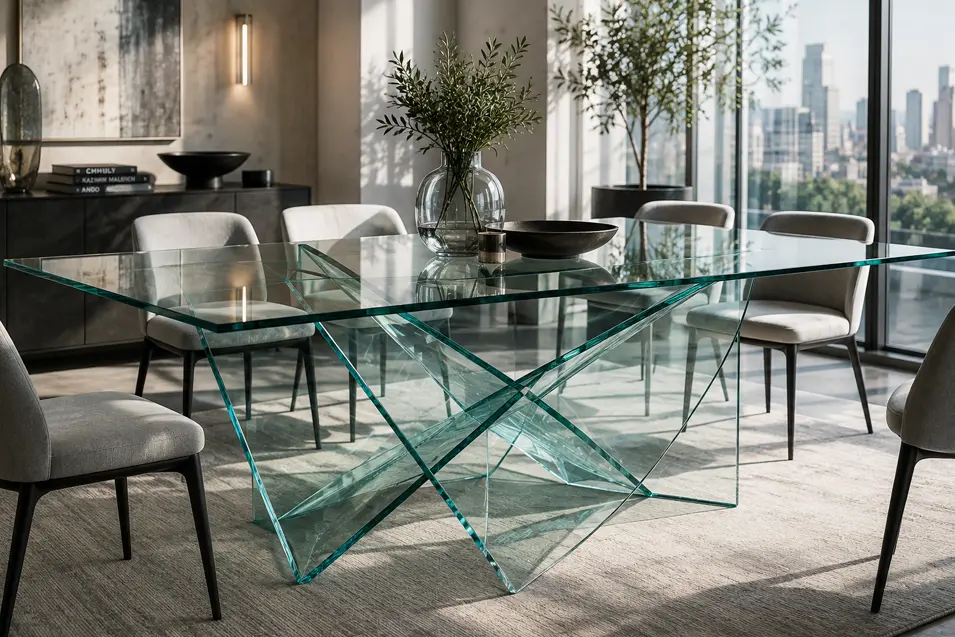
The glazier doesn’t see a sheet of glass.
They see structure.
Several enormous pieces of thick architectural glass intersect beneath a perfectly clear tabletop, creating a base that changes depending on where you stand. Polished edges catch the light while carefully engineered connections appear almost invisible.
There is nowhere for poor workmanship to hide.
Every cut, angle and connection can be seen directly through the furniture.
In a bright contemporary dining room, the table almost disappears, leaving chairs and objects seemingly suspended around it.
It would also reveal every fingerprint within a five-kilometre radius.
Beautiful things occasionally demand sacrifice.
The Stonemason’s Bench
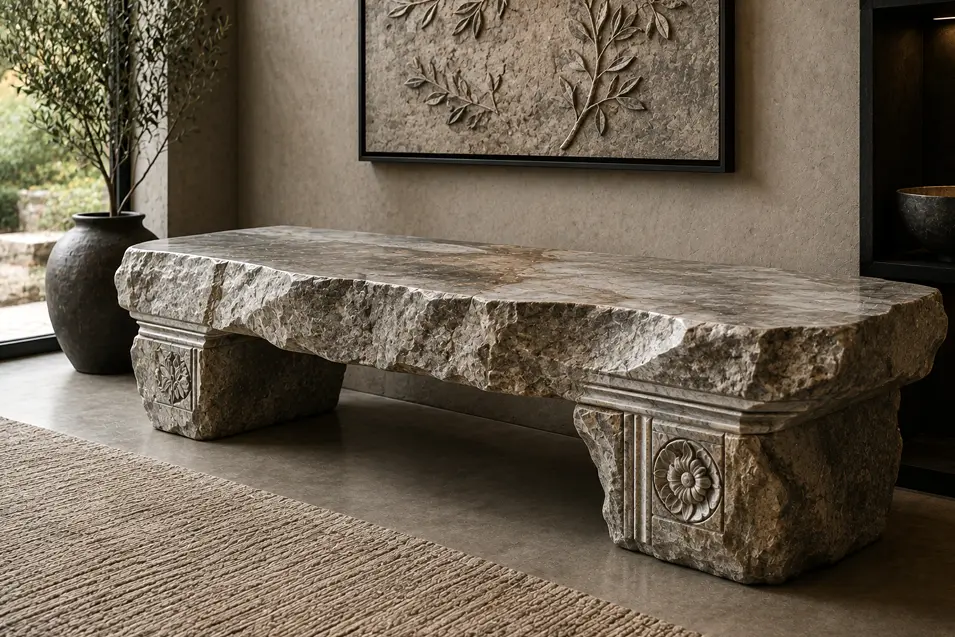
A stonemason has no reason to pretend stone is something it isn’t.
So this bench is unapologetically massive.
A single slab of beautifully veined stone forms the seat while hand-carved supports appear to emerge naturally from beneath it. Portions remain rough and irregular, preserving the character of the original material, while areas touched by the body have been polished smooth.
Traditional carved details appear unexpectedly along the edges.
It’s part furniture, part architecture and part sculpture.
You aren’t going to casually drag it across the room because company is coming over.
Where the stonemason puts the bench is where the bench lives now.
The Roofer’s Lounge Chair
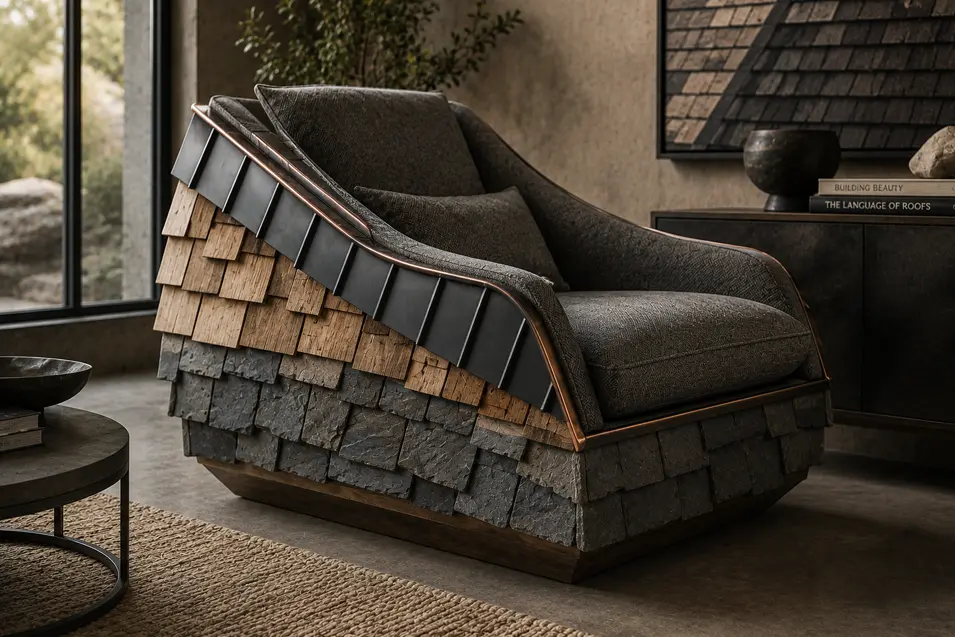
Roofing materials spend their lives protecting buildings from some fairly miserable conditions.
Surely they can survive a living room.
The lounge chair begins with a simple frame but becomes increasingly elaborate as overlapping materials climb across its surface. Cedar shakes create one section, pieces of standing-seam metal sweep around another and small slate tiles form a surprisingly beautiful outer shell.
The layers overlap exactly as they would on a roof.
From behind, the chair looks almost architectural.
From the front, thick upholstery provides enough comfort that you don’t actually feel like you’re sitting on someone’s garage.
Which seems like an important design achievement.
The Plumber’s Bathroom Vanity
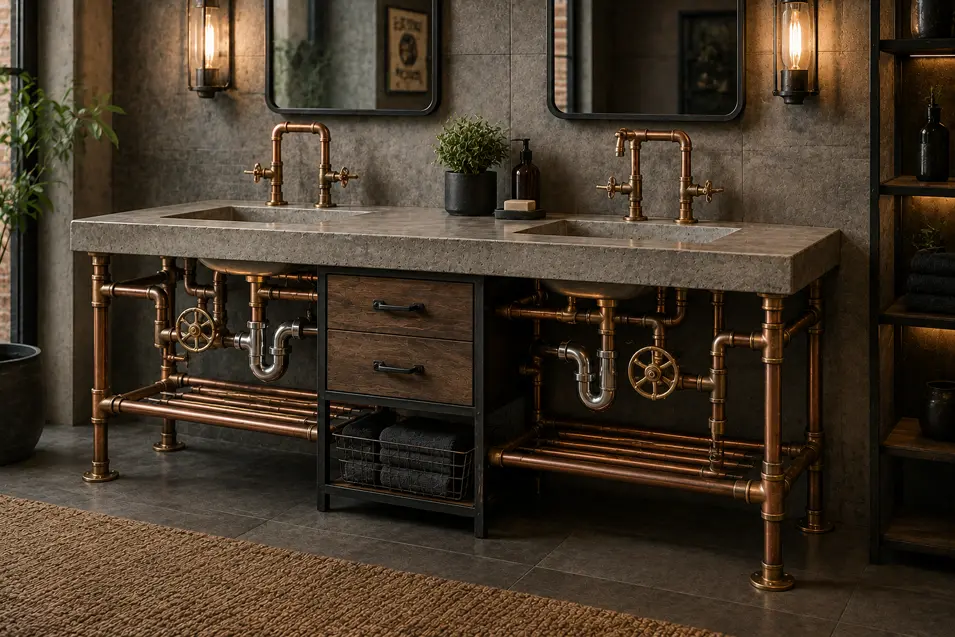
This one almost makes too much sense.
Instead of hiding the plumbing beneath a bathroom vanity, the plumber makes it the entire point.
Beautiful copper supply lines travel openly beneath a thick countertop, bending neatly around drawers and connecting to oversized exposed valves. Drain pipes are polished and deliberately symmetrical.
The cabinet itself is restrained because the plumbing provides all the visual complexity it needs.
Even the faucets appear to have been assembled from industrial fittings.
Normally, exposed pipes suggest somebody hasn’t finished the renovation.
Here, hiding them would ruin the furniture.
The HVAC Technician’s Media Console
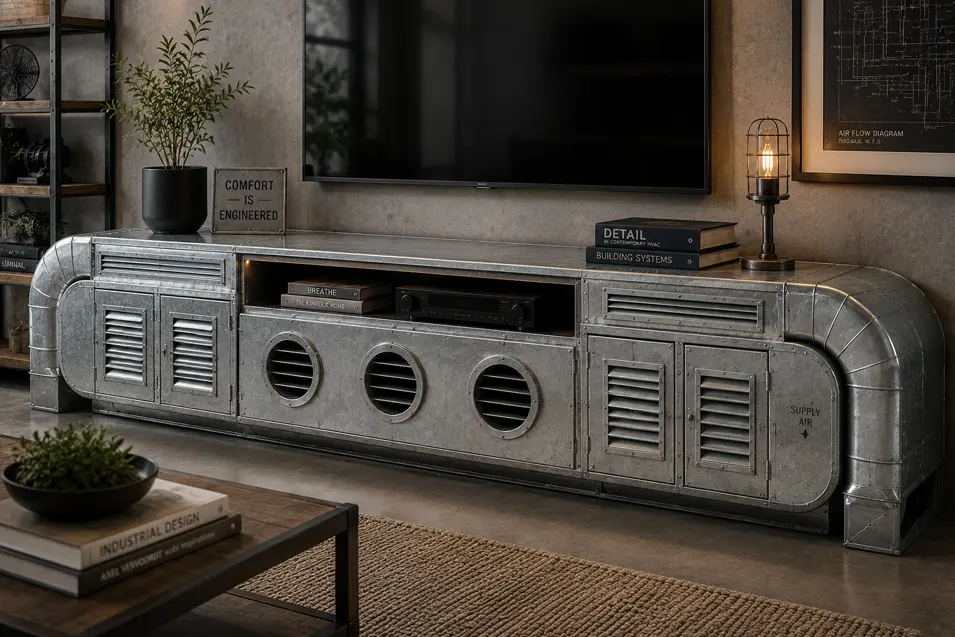
Ductwork isn’t known for being particularly glamorous.
Our HVAC technician takes that personally.
Galvanized sheet metal is folded into a long low media console with beautifully crisp seams, rounded duct transitions and louvered doors inspired by commercial ventilation systems.
Circular vents become cable-management openings. Small registers provide actual ventilation for electronics inside the cabinet.
The whole thing looks slightly like part of an extremely expensive mechanical room escaped and found its way into the living room.
Which, strangely enough, works.
The Blacksmith’s Bed
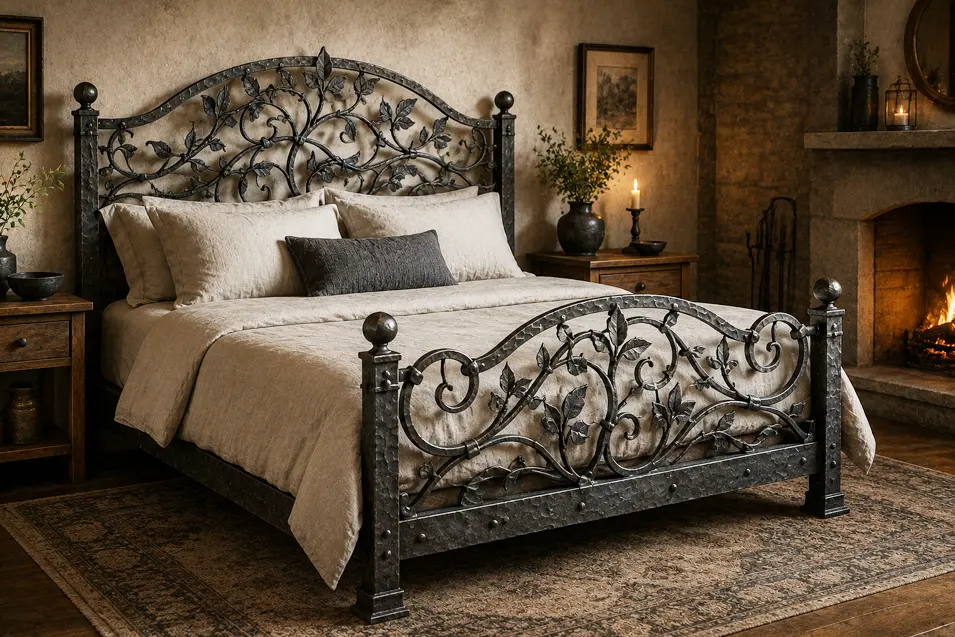
The blacksmith isn’t ordering a metal bed frame from a catalogue.
Every piece of this one looks forged.
Heavy iron uprights rise at each corner while hand-hammered rails twist and curve between them. The headboard becomes an elaborate composition of leaves, scrolls and organic forms, all shaped from glowing metal rather than cast from a mould.
Hammer marks remain visible across the surface.
Small variations remind you that two supposedly identical elements were actually made by hand.
Against simple linen bedding, all that black iron becomes surprisingly romantic.
It’s the sort of bed that could survive several generations.
Possibly several buildings.
The Drywaller’s Bookcase
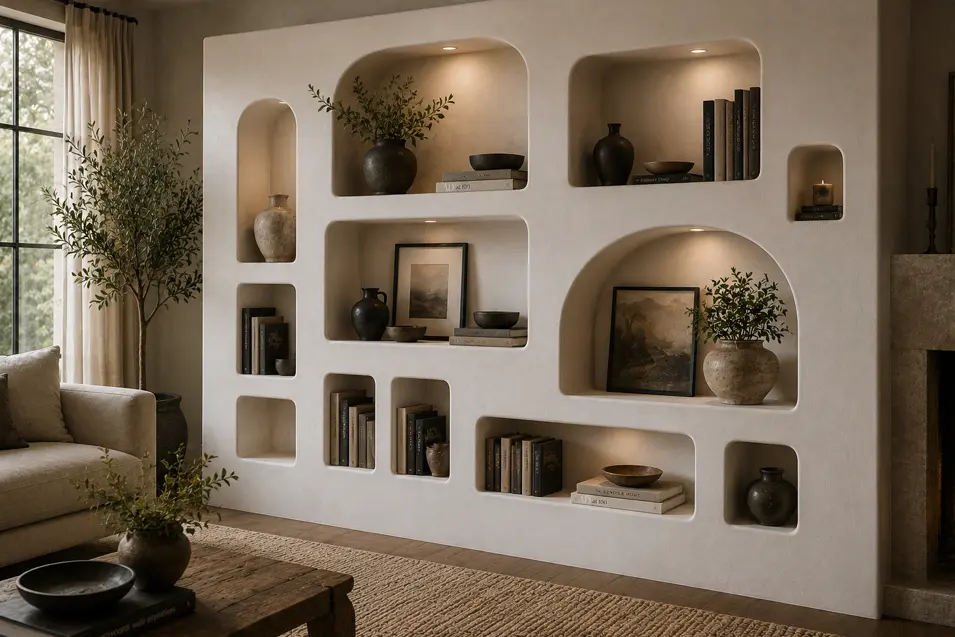
This sounded like one of the stupidest ideas in the collection.
Then it became strangely beautiful.
Rather than building a conventional bookcase and covering it with drywall, the entire piece becomes a miniature architectural wall. Niches of different sizes are recessed into a thick white structure, with perfectly finished corners and subtle curves connecting several openings.
There are no visible shelves.
Books, pottery and artwork simply disappear into openings carved from the wall-like form.
It blurs the distinction between furniture and architecture so completely that visitors might wonder whether the room was built around it.
Just don’t kick the bottom shelf.
The Painter’s Accent Chair
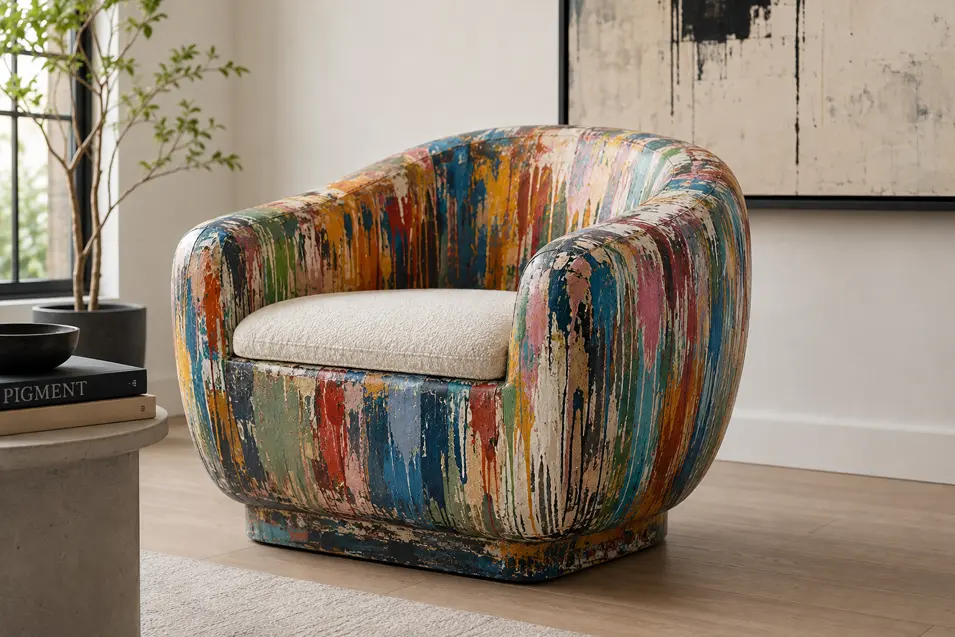
The painter gets colour.
Lots of it.
Rather than simply painting a chair, decades of imagined paint layers become the material from which the chair appears to have been created.
Bands of colour build across the arms and shell. Drips remain visible along selected edges. Areas have been sanded back to reveal older colours beneath newer ones, creating something resembling geological strata made from paint.
The shape itself stays relatively simple.
It doesn’t need to compete with the surface.
Put this chair in an otherwise restrained room and nothing else needs to happen.
The Flooring Installer’s Dining Table
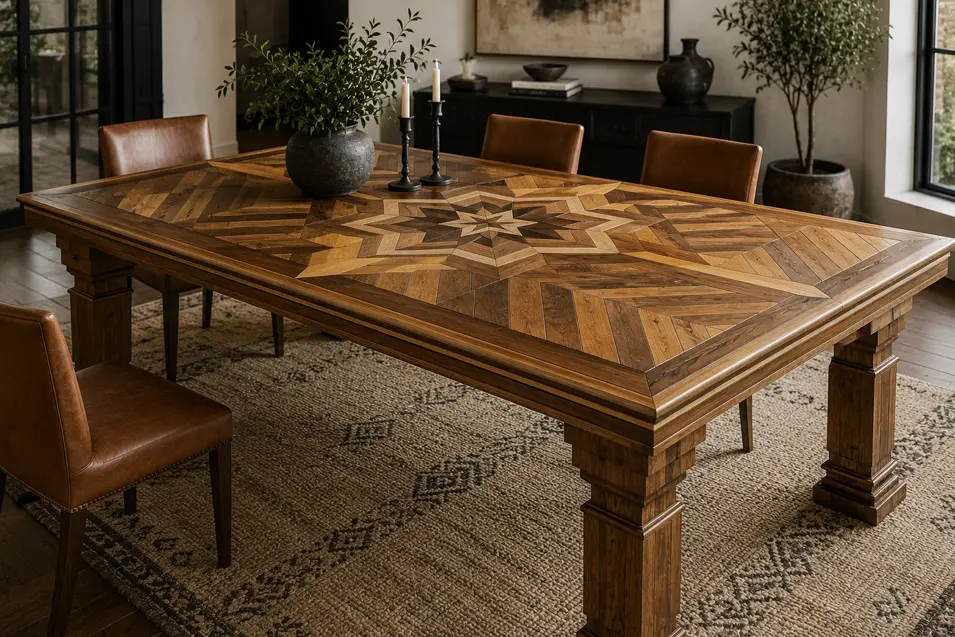
The flooring installer has spent years creating beautiful surfaces only for people to walk all over them.
This time, the floor gets promoted.
The top of a massive dining table is assembled like an elaborate hardwood floor, with different species forming parquet patterns that shift from herringbone to chevron and finally into an intricate central medallion.
The edges reveal the layered construction beneath.
Heavy timber legs borrow details from traditional thresholds and stair components.
It’s essentially an extraordinary floor raised thirty inches into the air.
And for once, nobody is allowed to walk on it.
The Auto Body Technician’s Lounge Chair
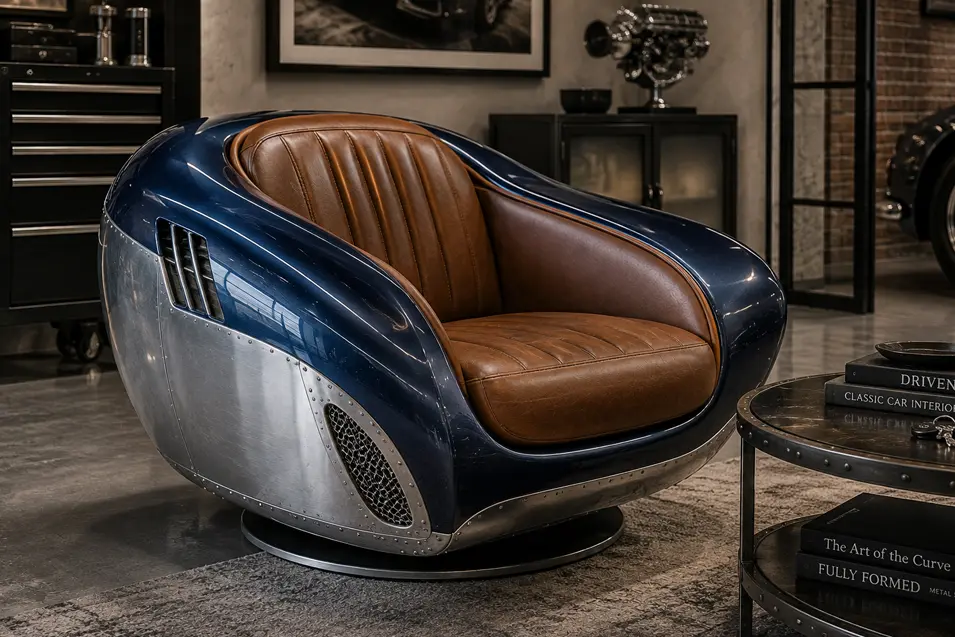
Few trades understand compound curves quite like someone who repairs automobile bodies.
That knowledge produces a lounge chair that looks fast while standing perfectly still.
Hand-shaped metal panels flow around the seat like the bodywork of a vintage sports car. Welded seams disappear beneath immaculate finishing, while sections of polished aluminum contrast with deep painted surfaces.
The upholstery borrows from classic automotive interiors without becoming a literal car seat.
Small ventilation openings and beautifully machined details complete the illusion.
You half expect to find a set of keys somewhere.
The Sheet Metal Worker’s Cabinet
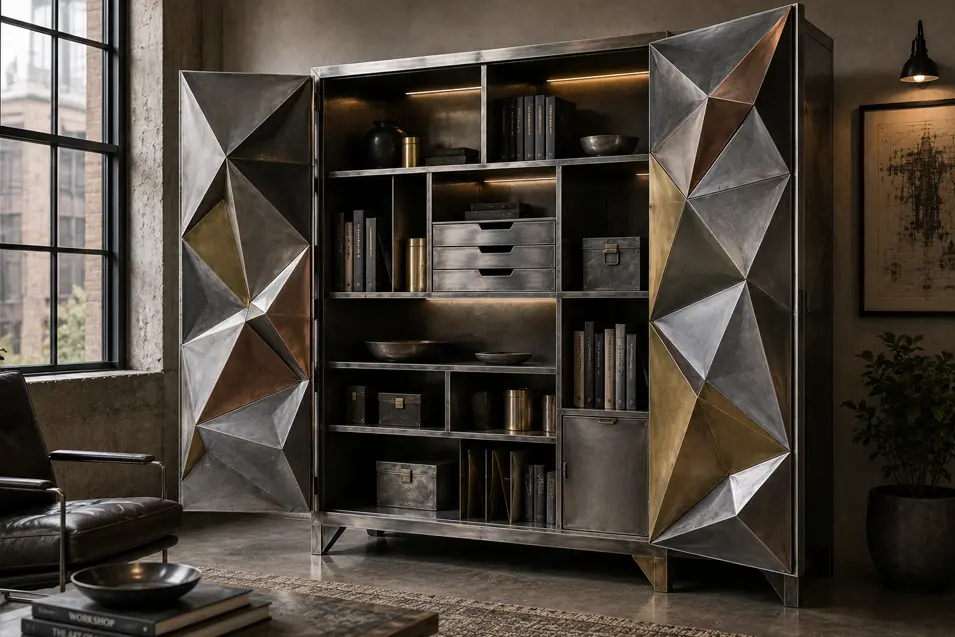
Give a sheet metal worker a flat piece of metal and it rarely stays flat for long.
This tall storage cabinet celebrates every fold.
The doors are formed from sharply creased sheets that create repeating three-dimensional patterns across the front. Corners wrap seamlessly around the cabinet while tiny folded returns replace conventional decorative trim.
Different metals introduce subtle changes in colour—zinc, blackened steel, brass and aluminum.
Open the doors and the precision continues inside with folded shelves and integrated compartments.
It’s industrial fabrication behaving like fine cabinetry.
The Plasterer’s Fireplace Surround
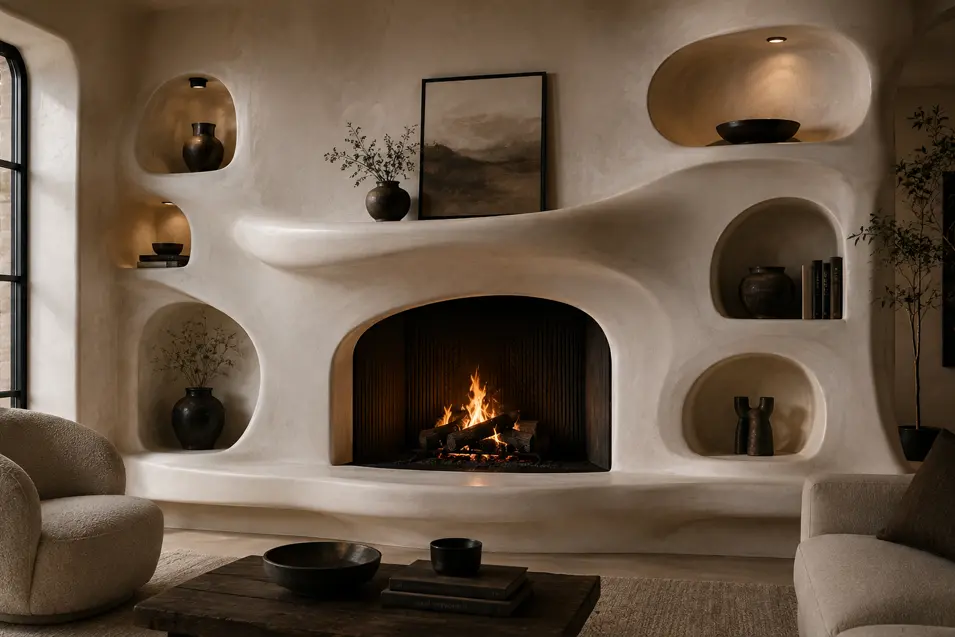
Plaster can make perfectly flat walls.
That doesn’t mean it has to.
Around this fireplace, the plasterer creates an enormous flowing composition that appears almost carved from the wall itself. Shelves emerge without visible joints. Rounded niches hold artwork and objects. The mantel sweeps outward before disappearing back into the surrounding surface.
Subtle hand-trowelled texture catches changing light throughout the day.
There isn’t a straight piece of trim anywhere.
It’s quiet compared with the electrician’s cables or the bricklayer’s masonry sofa, but that’s exactly why it works.
Craftsmanship doesn’t always need to shout.
The Cabinetmaker’s Ultimate Bar
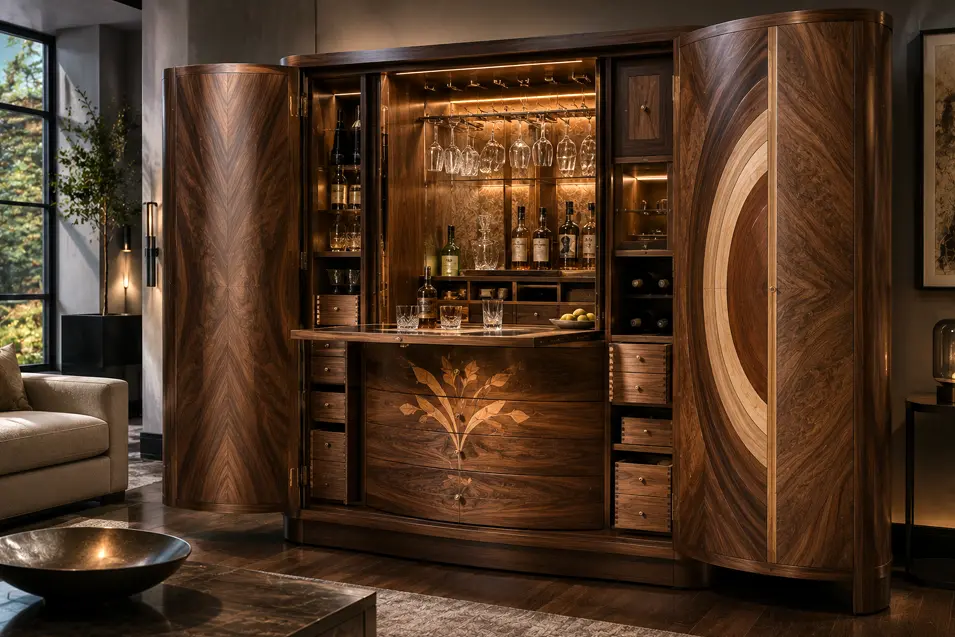
We should probably finish with somebody who actually makes furniture for a living.
And apparently they’ve decided to show off.
The cabinetmaker’s bar combines complex curved doors, book-matched veneers, hidden compartments, intricate marquetry and drawers fitted so precisely they seem to move on air.
Different hardwoods create subtle patterns rather than dramatic colour changes. Hardware is minimal. Several doors disappear entirely into the surrounding panels when closed.
Then the bar opens.
Interior lighting reveals glassware storage, bottle racks, serving surfaces and compartments tucked into spaces you didn’t realize existed.
After nineteen trades reinterpret furniture using the materials they understand best, the cabinetmaker provides the reminder that extraordinary furniture has always been its own trade.
Maybe the Trades Should Design More Furniture
Obviously, nobody needs a brick sofa.
We are also reasonably certain electrical cable will not replace upholstery anytime soon.
But underneath the absurdity is something furniture design has always depended upon: understanding materials.
Wood wants to behave differently from steel. Glass presents different opportunities than stone. Copper pipe, brick, tile, concrete and sheet metal each come with limitations—but those limitations are often what make interesting design possible.
Tradespeople spend entire careers learning those characteristics.
Take their materials out of the places we normally expect to find them, apply the same skills to furniture and suddenly something familiar becomes completely different.
Some of these pieces should probably remain imaginary.
That carpenter’s sofa, though?
Someone needs to build that thing.