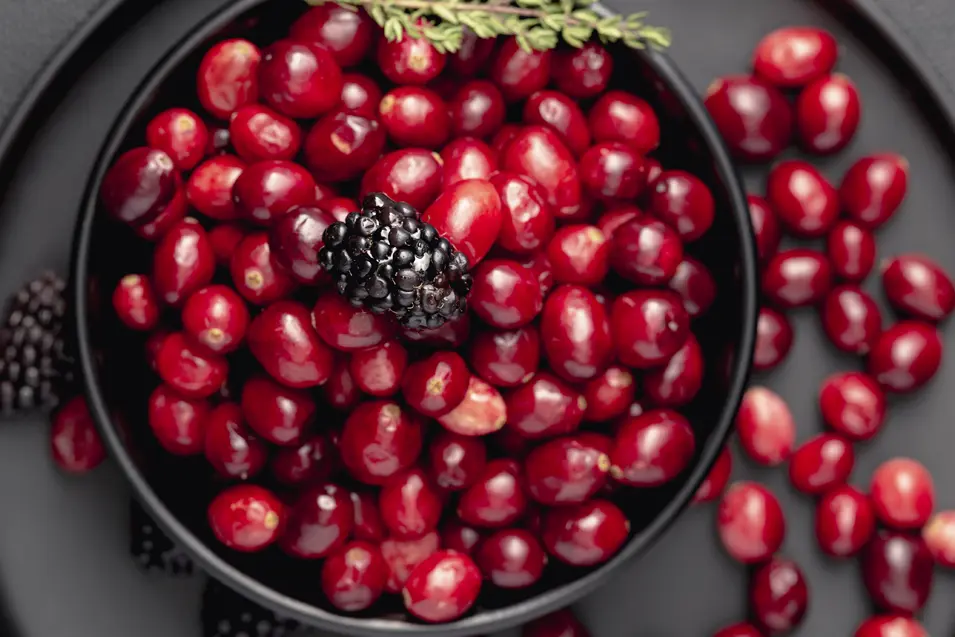
Cranberries join blueberries and Concord grapes as one of the very few fruits that are indigenous to North America.
Early Native Americans prized cranberries for their myriad of versatile uses. They mixed mashed berries with dried deer meat to make long-lasting pemmican (the benzoic acid in cranberries makes them a natural preservative). They also found that cranberries provided a variety of medicinal uses and utilized the berries’ intensely colored juices as a natural red dye.
After the Pilgrims landed at Plymouth Rock, they too began incorporating cranberries into their daily life. To this day, the cranberry remains a New England culinary staple.
Dutch and German settlers called the bright red fruit “crane berries” because their flowers, when in bloom, resembled the head of a crane. Our modern name “cranberry” evolved from that earlier usage.
Growing and Harvesting Cranberries
Cranberries grow on low vines in marshes and sandy bogs. The common image of cranberries growing in water is actually based on the harvesting process. First, the berries are handpicked from their vines; in larger crops, special machinery is used for this purpose. Next, the bog is flooded with knee-high water, which allows the harvesting machinery to gather the rest of the berries more easily. The main difference is that dry-harvested cranberries are marketed as fresh berries, while wet-harvested cranberries are sold to processing plants for juices, sauces, and other food products.
Major cranberry producers include Massachusetts, Wisconsin, Washington, New Jersey, and Oregon, with their growing season spanning October through December.
When shopping for fresh cranberries, look for plump berries with bright, shiny skin. Their scarlet tone can range from light to dark red. Truly fresh cranberries will bounce; while bouncing berries in the supermarket is not realistic, it is good to keep in mind that the berry should be “bouncy” – firm, plump, and smooth.
Frozen cranberries are available year-round. Other popular cranberry products include cranberry juice and cranberry juice cocktails, which now include blends with apple, raspberry, or grape juices. Canned cranberry sauce comes in both whole-berry and jelled varieties.
Craisins, dried cranberries similar to raisins, have gained recent popularity. A simple yet beautiful salad idea is to toss craisins and sugared pecan halves with spring greens and a light vinaigrette, then top with a small round of goat cheese. Craisins are also delicious in muffins or other baked goods. To plump craisins, soak them in a cup of boiling or very hot water for 15 minutes.
When cooking cranberries, you can reduce some of their tartness by adding ¼ teaspoon of baking soda to 3 cups of berries. Only cook them until they pop, or they will taste bitter. Cooked cranberries will last up to a month if kept tightly covered. Adding a bit of liqueur will extend their shelf life.
Before storing cranberries, be sure to weed out any mushy berries. One bad cranberry can cause the entire bunch to spoil quickly. You can refrigerate fresh cranberries for up to two months in a zip-lock bag.
To freeze cranberries, wash and dry them first. Cranberries freeze well and can be kept for up to a year.
Here is a recipe for a traditional morning treat. To adapt it for a luncheon or brunch buffet, score each into eight smaller wedges.
Cranberry Scones
¾ cup yogurt (you can substitute buttermilk)
1 egg
2 ¾ cups flour
4 teaspoons baking powder
½ teaspoon baking soda
½ teaspoon salt
½ cup butter
1 cup cranberries (fresh or frozen), coarsely chopped
½ cup sugar
1 tablespoon grated orange rind
1 tablespoon butter, melted
¼ cup confectioners’ sugar
Directions:
Preheat oven to 375 degrees.
In a small bowl, beat yogurt and egg until well combined. Set aside.
In a large bowl, combine flour, baking powder, baking soda, and salt.
Cut in butter.
Mix in cranberries, sugar, and orange rind.
Stir in yogurt mixture.
Turn dough out onto a floured surface and pat into a large ball.
Knead about 10 times.
Pat into two 1” thick circles.
Place on an ungreased cookie sheet.
Score both circles into quarters to make 4 wedges from each circle.
Bake at 375 degrees for 15-20 minutes.
Move to a wire rack.
Brush tops with butter and sprinkle with confectioners’ sugar.