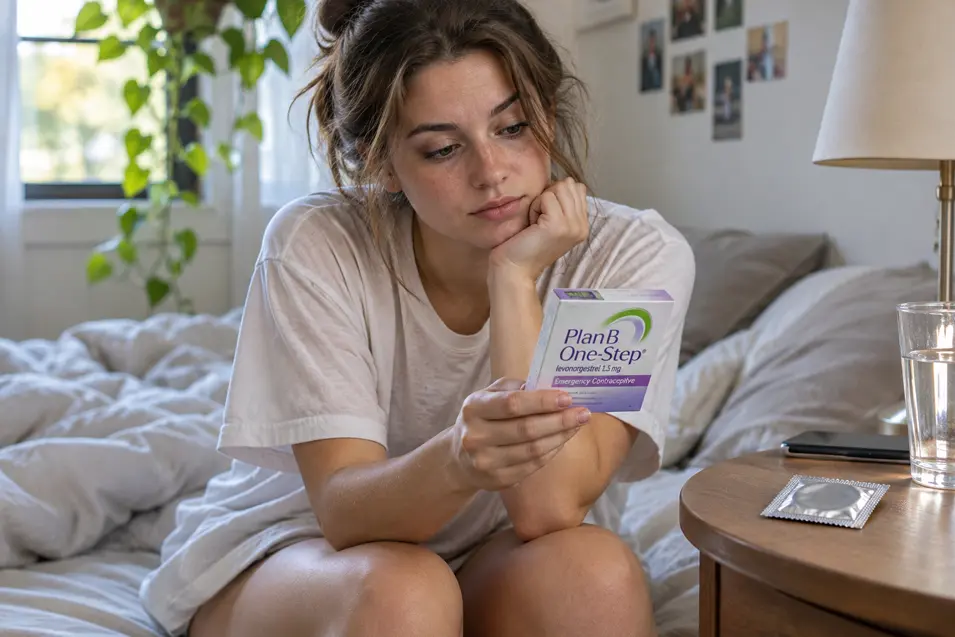
Why bother using birth control tonight when you can simply take the morning-after pill tomorrow?
It might sound like a convenient solution. There’s no need to remember to take a daily birth control pill, worry about having condoms available or interrupt an intimate moment to discuss contraception.
Have sex tonight. Stop at the pharmacy tomorrow. Problem solved.
Except that pregnancy prevention doesn’t necessarily work that way.
The availability of emergency contraception is an important advancement in reproductive healthcare. It provides women with an additional option when contraception fails, unprotected sex occurs or circumstances are beyond their control.
However, there is a considerable difference between having a backup plan and deliberately making your backup plan your primary method of birth control.
The Plan B pill serves an important purpose, but it shouldn’t be your Plan A.
What Is the Plan B Pill?
Plan B One-Step is an emergency contraceptive containing 1.5 milligrams of levonorgestrel, a synthetic hormone also found in certain regular contraceptive medications.
The original Plan B product received FDA approval in 1999. Today, Plan B One-Step and generic equivalents are available without a prescription or minimum age requirement in the United States.
Commonly referred to as the morning-after pill, it is designed to reduce the likelihood of pregnancy following unprotected sexual intercourse or contraceptive failure.
Situations where emergency contraception may be appropriate include:
- A condom breaking or slipping off.
- Missing regular birth control pills.
- Having sex without contraception.
- Experiencing another form of contraceptive failure.
- Sexual assault.
Taking emergency contraception when needed is a responsible healthcare decision. Nobody should be embarrassed about purchasing it or made to feel guilty for using it.
However, understanding how it works — and when it may not work — is essential.
How Does Plan B Actually Work?
According to the U.S. Food and Drug Administration (FDA), Plan B primarily prevents pregnancy by interfering with ovulation.
Ovulation occurs when an ovary releases an egg. By preventing or delaying that release, levonorgestrel can reduce the opportunity for fertilization.
Here is where relying on Plan B becomes problematic.
If ovulation has already occurred, the medication may not prevent pregnancy.
Most women cannot determine precisely when they ovulate. Even someone with relatively predictable menstrual cycles may experience variations from one month to the next.
Period-tracking applications can provide estimates, but they cannot reliably confirm the exact moment ovulation occurs.
Taking Plan B after unprotected sex does not guarantee that pregnancy has been prevented.
How Effective Is the Morning-After Pill?
The World Health Organization (WHO) reports pregnancy rates of approximately 1.2% to 2.1% in studies involving levonorgestrel emergency contraception.
To put those figures into perspective:
| Number of Users | Estimated Pregnancies Based on Study Rates |
|---|---|
| 100 | Approximately 1–2 |
| 1,000 | Approximately 12–21 |
| 10,000 | Approximately 120–210 |
These are illustrations based on observed study rates, not predictions of an individual woman’s likelihood of becoming pregnant.
They also should not be interpreted as meaning Plan B prevents 98% to 99% of all pregnancies that would otherwise occur. Not every episode of unprotected intercourse would have resulted in pregnancy.
Effectiveness varies depending on circumstances, including when the medication is taken and where someone is in their menstrual cycle.
The practical takeaway is that emergency contraception reduces the risk of pregnancy but does not eliminate it.
Why Waiting Until Tomorrow Isn’t a Good Strategy
The phrase morning-after pill can be somewhat misleading.
There is no reason to deliberately wait until the following morning to take emergency contraception.
The sooner levonorgestrel is taken following unprotected sex, the better its chances of working.
FDA-approved directions for Plan B recommend taking it within 72 hours. Medical guidance recognizes that levonorgestrel may provide some benefit beyond this period, up to five days, although its effectiveness declines.
Consider what can happen when someone deliberately plans to purchase emergency contraception the following day.
The pharmacy may be closed. The medication may be unavailable. Transportation may be an issue. Someone may forget, become distracted or decide that purchasing it is unnecessary.
There may also be financial concerns, embarrassment or disagreements between partners about who should pay for it.
And even if everything goes according to plan, ovulation may already have occurred.
You are introducing uncertainties that could have been reduced by arranging contraception beforehand.
Not All Emergency Contraception Is the Same
Although Plan B is one of the best-known emergency contraceptive products, other options exist.
The Centers for Disease Control and Prevention (CDC) identifies several emergency contraceptive methods.
| Method | Recommended Timing | Availability in the United States |
|---|---|---|
| Levonorgestrel (Plan B and generics) | Ideally within 72 hours; some benefit may extend to 120 hours | Over the counter |
| Ulipristal acetate (ella) | Within 120 hours | Prescription required |
| Copper IUD | Generally within five days | Healthcare professional required |
Ulipristal acetate is generally more effective than levonorgestrel when taken three to five days after intercourse.
A copper intrauterine device is more than 99% effective when inserted within the recommended emergency contraception window and can remain in place for ongoing pregnancy prevention.
A pharmacist or healthcare professional can help determine which option is most appropriate based on timing, medications, medical history and other individual circumstances.
Does Body Weight Affect Plan B’s Effectiveness?
Many people are unaware that body weight may influence the effectiveness of certain emergency contraceptive pills.
Research suggests that levonorgestrel may be less effective in women with obesity.
The evidence does not establish a precise body weight at which Plan B suddenly becomes ineffective. Online claims suggesting a universal weight cutoff can therefore be misleading.
Ulipristal acetate or a copper IUD may be more appropriate options in some circumstances.
Women should not avoid emergency contraception simply because of their weight. Instead, they should promptly discuss available options with a pharmacist or healthcare professional.
This is another reason why relying exclusively on Plan B without understanding its limitations is not an ideal contraceptive strategy.
Can You Take Plan B Multiple Times?
Yes.
One of the misconceptions surrounding emergency contraception is that taking it repeatedly will permanently damage a woman’s reproductive system.
Current evidence does not support that claim.
Repeated use of levonorgestrel emergency contraception has not been shown to cause permanent infertility or significant long-term health problems in most users.
However, repeated use can increase the likelihood of menstrual irregularities and other temporary side effects.
These may include:
- Nausea.
- Headaches.
- Fatigue.
- Abdominal discomfort.
- Breast tenderness.
- Spotting or unexpected bleeding.
- Changes in the timing of menstrual periods.
If you find yourself purchasing emergency contraception regularly, it may be worth reconsidering your contraceptive arrangements.
That recommendation is based primarily on effectiveness and practicality, not on the assumption that using Plan B repeatedly will cause permanent physical harm.
Taking Plan B Doesn’t Protect You for the Rest of the Month
Another misconception is that taking emergency contraception provides protection against pregnancy for several days or until the next menstrual period.
It does not provide reliable ongoing protection.
Because levonorgestrel may delay ovulation, someone could still ovulate later in the same menstrual cycle.
Having unprotected sex again after taking Plan B creates another potential pregnancy risk.
After using levonorgestrel emergency contraception, regular hormonal birth control can generally be started or resumed immediately. CDC guidance recommends using condoms or avoiding intercourse for the following seven days.
The recommendations are different for ulipristal acetate, which generally requires waiting five days before starting or resuming hormonal contraception.
This distinction illustrates why understanding which medication you have taken is important.
Emergency Contraception Versus Regular Birth Control
Women today have numerous contraceptive options.
Those who dislike taking a daily pill are not necessarily limited to condoms or emergency contraception.
The CDC’s contraceptive effectiveness information provides the following estimates for pregnancy rates during the first year of typical use.
| Contraceptive Method | Annual Typical-Use Failure Rate |
|---|---|
| Hormonal implant | 0.1% |
| Hormonal IUD | 0.1–0.4% |
| Copper IUD | 0.8% |
| Birth control injection | 4% |
| Birth control pill | 7% |
| Birth control patch | 7% |
| Vaginal contraceptive ring | 7% |
| External condom | 13% |
These figures account for ordinary human behavior, including missed pills, incorrect use and other common mistakes.
Emergency contraception is not included in this table because pregnancy rates following individual uses cannot be directly compared with annual failure rates for ongoing contraceptive methods.
There is no reliable basis for simply multiplying Plan B’s observed pregnancy rate by the number of times someone takes it to calculate their annual pregnancy risk.
Nevertheless, regular contraception provides a more practical and generally more reliable approach to pregnancy prevention.
The Financial Cost of Using Plan B as Birth Control
Emergency contraception can become expensive when purchased repeatedly.
Imagine someone paying $40 for a dose of emergency contraception.
| Frequency of Purchase | Annual Expenditure |
|---|---|
| Once every three months | $160 |
| Once a month | $480 |
| Twice a month | $960 |
| Once a week | $2,080 |
These are hypothetical calculations based on a $40 purchase price, not a national average.
Generic levonorgestrel products may cost considerably less than the brand-name medication. Prices, insurance coverage and access to discounted products vary.
Meanwhile, regular contraceptive methods may be available at reduced or no out-of-pocket cost through insurance plans, community health centers and family planning programs.
For someone repeatedly purchasing emergency contraception, discussing affordable ongoing birth control options with a healthcare provider may make considerable financial sense.
What About Sexually Transmitted Infections?
In the hours following unprotected sex, concerns about pregnancy may overshadow other health considerations.
However, pregnancy is not the only potential consequence of unprotected intercourse.
Plan B offers no protection against sexually transmitted infections (STIs), including chlamydia, gonorrhea, syphilis, HIV, genital herpes and human papillomavirus (HPV).
Many sexually transmitted infections can be present without noticeable symptoms.
Someone may appear perfectly healthy while carrying an infection they are unaware of.
Correct and consistent condom use reduces the risk of many sexually transmitted infections. Emergency contraception does not.
For individuals with new sexual partners or partners whose STI status is unknown, condoms remain an important consideration regardless of whether another contraceptive method is being used.
A person who believes they may have been exposed to HIV should seek urgent medical advice, as preventive treatment following exposure must be started within 72 hours.
Preventing pregnancy and protecting sexual health are related but distinctly different responsibilities.
Why Is Birth Control Still Being Treated as a Woman’s Responsibility?
There is another aspect of relying on Plan B that deserves greater attention.
Two people decide to have sex without contraception.
Only one of them needs to take the medication the following morning.
Only one experiences the potential side effects.
Only one waits to find out whether their menstrual period arrives.
And only one physically experiences the pregnancy if emergency contraception fails.
Yet some men are remarkably comfortable suggesting that their partners can simply take the morning-after pill instead of using a condom.
Perhaps condoms are inconvenient. Perhaps they claim sex feels different. Perhaps they simply don’t want to interrupt the moment.
But expecting another person to take medication afterward because you don’t want to use contraception beforehand is hardly an example of shared responsibility.
Men should be involved in conversations about pregnancy prevention before sexual intercourse takes place.
They should understand how contraception works, contribute to its cost where appropriate and respect their partner’s preferences and boundaries.
A woman should never feel pressured into having unprotected sex because her partner insists that emergency contraception will solve everything.
If someone is mature enough to participate in a sexual relationship, they should also be mature enough to discuss contraception.
When a Backup Plan Creates False Confidence
Having access to emergency contraception is reassuring.
However, that reassurance can become problematic if someone begins to believe it eliminates the consequences of deliberately having unprotected sex.
Consider the following statements:
“I’ll just take Plan B tomorrow.”
“I’m probably not ovulating anyway.”
“We’ll be more careful next time.”
“He said he would pull out.”
“I’ve taken the morning-after pill before, and everything was fine.”
None of these statements guarantees that pregnancy will be prevented.
Previous experiences do not establish future effectiveness.
Someone who has taken emergency contraception several times without becoming pregnant should not assume the medication will work every time.
It is also important not to assume that everyone repeatedly using emergency contraception is making careless decisions.
Some individuals experience difficulties accessing healthcare, cannot tolerate certain contraceptive medications, face financial barriers or have partners who interfere with their contraceptive choices.
Others may have infrequent sexual encounters and struggle to identify a suitable ongoing method.
Those circumstances deserve practical support rather than criticism.
The objective should be to help people find contraceptive arrangements that work for their lives.
Does Plan B Cause an Abortion?
No.
Plan B is not an abortion pill.
Levonorgestrel emergency contraception works before pregnancy is established by preventing or delaying ovulation.
It cannot terminate an existing pregnancy.
The medications used for medication abortion are different from levonorgestrel emergency contraception and serve a different medical purpose.
Confusing these medications can create unnecessary fear and discourage people from obtaining appropriate healthcare.
When Should You Take a Pregnancy Test After Plan B?
Emergency contraception can temporarily change the timing of your next menstrual period.
Your period may arrive earlier or later than expected, and bleeding may differ from what you normally experience.
However, a missed period should not automatically be attributed to the medication.
Taking a pregnancy test approximately three weeks after unprotected intercourse is a reasonable way to check whether pregnancy has occurred.
If your period is more than a week late, consider taking a pregnancy test.
If you experience severe abdominal pain, fainting or unusual heavy bleeding, seek medical attention promptly. These symptoms may indicate a medical condition requiring assessment, including a possible ectopic pregnancy.
Emergency contraception does not cause ectopic pregnancy, but an ectopic pregnancy must be considered when pregnancy occurs and concerning symptoms develop.
If you vomit shortly after taking emergency contraception, contact a pharmacist or healthcare professional, as another dose may be necessary.
A Conversation Worth Having With Teenagers
Parents discussing birth control with teenagers should include emergency contraception in those conversations.
Teenagers need to understand that the morning-after pill exists, where reliable information is available and when it may be appropriate to use it.
They also need to understand its limitations.
A teenage girl may believe that taking Plan B is easier than discussing regular birth control with her parents or arranging a medical appointment.
A teenage boy may assume that emergency contraception makes condoms unnecessary.
Both misunderstandings deserve attention.
Parents should avoid presenting emergency contraception as something shameful or morally unacceptable. Doing so may discourage a teenager from using it when it is genuinely needed.
Instead, explain the difference between planning for contraception and responding to a situation where contraception was absent or unsuccessful.
These conversations should also address consent, healthy relationships, sexually transmitted infections and shared responsibility.
The objective is not simply to prevent teenage pregnancy. It is to help young people develop responsible sexual health habits that will serve them throughout adulthood.
Having Plan B Available Is Not the Problem
There is nothing wrong with purchasing emergency contraception in advance and keeping it available in case it is needed.
In fact, doing so can eliminate delays when an unexpected situation occurs.
Keep it stored according to the manufacturer’s directions and pay attention to the expiration date.
The problem is not having emergency contraception available.
The problem is deliberately relying on it because discussing or arranging contraception beforehand seems inconvenient.
There is a difference between keeping a backup and choosing not to have a primary plan.
One reflects preparation. The other introduces avoidable uncertainty.
The Plan B Pill Shouldn’t Be Your Plan A
Emergency contraception has an important place in modern reproductive healthcare.
It provides an additional opportunity to prevent pregnancy when circumstances don’t go according to plan. It should remain accessible, and nobody should feel ashamed about using it.
But if you are old enough to make decisions about having sex, you are also old enough to have conversations about contraception.
If you dislike taking a daily birth control pill, explore other options.
If your partner refuses to wear condoms, discuss why your health and concerns are being dismissed.
If contraception is too expensive or difficult to obtain, speak with a healthcare professional or community family planning provider about alternatives.
And if you need emergency contraception, use it promptly rather than allowing embarrassment or fear of judgment to delay your decision.
Plan B is a valuable second chance.
It was never intended to replace the first conversation you should have had before taking your clothes off.
Read More: Birth Control, Sexual Health and Personal Responsibility
Making informed decisions about sexual health involves understanding pregnancy risks, contraceptive options and the importance of communication. These related articles explore the responsibilities that accompany sexual relationships.
- Mom, I Want to Go on the Pill – Explore modern contraceptive options, birth control safety and how parents can support teenagers in making informed decisions about reproductive health.
- What Are My Odds of Getting Pregnant? – Examine common questions and misconceptions surrounding pregnancy risks, contraceptive failure and unprotected sex.
- Dating Advice for Teens – Discover the importance of establishing personal boundaries, developing healthy relationships and resisting pressure to become sexually active.